 Add to Chrome
 Add to Firefox
 Add to Edge
From Rows to Reasoning: A Retrieval-Augmented Multimodal Framework for Spreadsheet Understanding
Jan 13, 2026
Large Language Models (LLMs) struggle to reason over large-scale enterprise spreadsheets containing thousands of numeric rows, multiple linked sheets, and embedded visual content such as charts and receipts. Prior state-of-the-art spreadsheet reasoning approaches typically rely on single-sheet compression or full-context encoding, which limits scalability and fails to reflect how real users interact with complex, multimodal workbooks. We introduce FRTR-Bench, the first large-scale benchmark for multimodal spreadsheet reasoning, comprising 30 enterprise-grade Excel workbooks spanning nearly four million cells and more than 50 embedded images. To address these challenges, we present From Rows to Reasoning (FRTR), an advanced, multimodal retrieval-augmented generation framework that decomposes Excel workbooks into granular row, column, and block embeddings, employs hybrid lexical-dense retrieval with Reciprocal Rank Fusion (RRF), and integrates multimodal embeddings to reason over both numerical and visual information. We tested FRTR on six LLMs, achieving 74% answer accuracy on FRTR-Bench with Claude Sonnet 4.5, a substantial improvement over prior state-of-the-art approaches that reached only 24%. On the SpreadsheetLLM benchmark, FRTR achieved 87% accuracy with GPT-5 while reducing token usage by roughly 50% compared to context-compression methods.

Don't Break the Cache: An Evaluation of Prompt Caching for Long-Horizon Agentic Tasks
Jan 09, 2026Recent advancements in Large Language Model (LLM) agents have enabled complex multi-turn agentic tasks requiring extensive tool calling, where conversations can span dozens of API calls with increasingly large context windows. However, although major LLM providers offer prompt caching to reduce cost and latency, its benefits for agentic workloads remain underexplored in the research literature. To our knowledge, no prior work quantifies these cost savings or compares caching strategies for multi-turn agentic tasks. We present a comprehensive evaluation of prompt caching across three major LLM providers (OpenAI, Anthropic, and Google) and compare three caching strategies, including full context caching, system prompt only caching, and caching that excludes dynamic tool results. We evaluate on DeepResearchBench, a multi-turn agentic benchmark where agents autonomously execute real-world web search tool calls to answer complex research questions, measuring both API cost and time to first token (TTFT) across over 500 agent sessions with 10,000-token system prompts. Our results demonstrate that prompt caching reduces API costs by 45-80% and improves time to first token by 13-31% across providers. We find that strategic prompt cache block control, such as placing dynamic content at the end of the system prompt, avoiding dynamic traditional function calling, and excluding dynamic tool results, provides more consistent benefits than naive full-context caching, which can paradoxically increase latency. Our analysis reveals nuanced variations in caching behavior across providers, and we provide practical guidance for implementing prompt caching in production agentic systems.
ScaleMCP: Dynamic and Auto-Synchronizing Model Context Protocol Tools for LLM Agents
May 09, 2025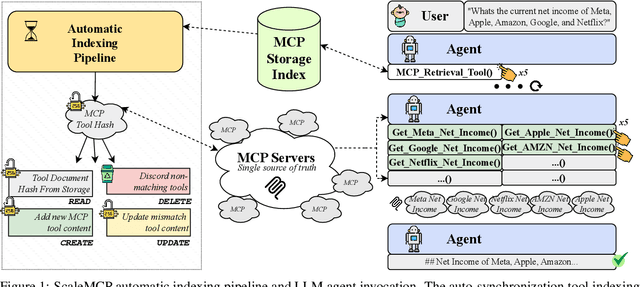
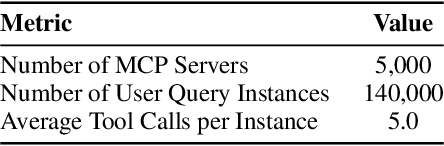
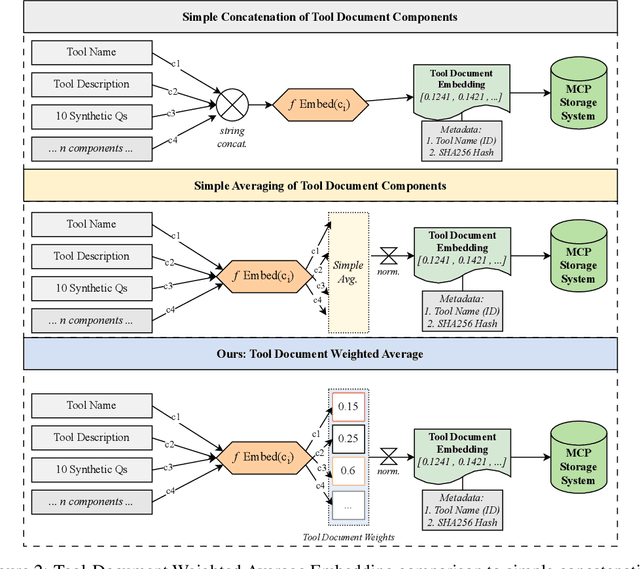
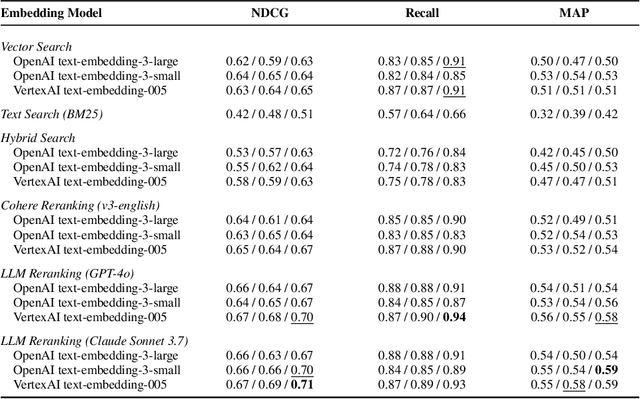
Recent advancements in Large Language Models (LLMs) and the introduction of the Model Context Protocol (MCP) have significantly expanded LLM agents' capability to interact dynamically with external tools and APIs. However, existing tool selection frameworks do not integrate MCP servers, instead relying heavily on error-prone manual updates to monolithic local tool repositories, leading to duplication, inconsistencies, and inefficiencies. Additionally, current approaches abstract tool selection before the LLM agent is invoked, limiting its autonomy and hindering dynamic re-querying capabilities during multi-turn interactions. To address these issues, we introduce ScaleMCP, a novel tool selection approach that dynamically equips LLM agents with a MCP tool retriever, giving agents the autonomy to add tools into their memory, as well as an auto-synchronizing tool storage system pipeline through CRUD (create, read, update, delete) operations with MCP servers as the single source of truth. We also propose a novel embedding strategy, Tool Document Weighted Average (TDWA), designed to selectively emphasize critical components of tool documents (e.g. tool name or synthetic questions) during the embedding process. Comprehensive evaluations conducted on a created dataset of 5,000 financial metric MCP servers, across 10 LLM models, 5 embedding models, and 5 retriever types, demonstrate substantial improvements in tool retrieval and agent invocation performance, emphasizing ScaleMCP's effectiveness in scalable, dynamic tool selection and invocation.
Gemini 1.5: Unlocking multimodal understanding across millions of tokens of context
Mar 08, 2024In this report, we present the latest model of the Gemini family, Gemini 1.5 Pro, a highly compute-efficient multimodal mixture-of-experts model capable of recalling and reasoning over fine-grained information from millions of tokens of context, including multiple long documents and hours of video and audio. Gemini 1.5 Pro achieves near-perfect recall on long-context retrieval tasks across modalities, improves the state-of-the-art in long-document QA, long-video QA and long-context ASR, and matches or surpasses Gemini 1.0 Ultra's state-of-the-art performance across a broad set of benchmarks. Studying the limits of Gemini 1.5 Pro's long-context ability, we find continued improvement in next-token prediction and near-perfect retrieval (>99%) up to at least 10M tokens, a generational leap over existing models such as Claude 2.1 (200k) and GPT-4 Turbo (128k). Finally, we highlight surprising new capabilities of large language models at the frontier; when given a grammar manual for Kalamang, a language with fewer than 200 speakers worldwide, the model learns to translate English to Kalamang at a similar level to a person who learned from the same content.
Gemini: A Family of Highly Capable Multimodal Models
Dec 19, 2023This report introduces a new family of multimodal models, Gemini, that exhibit remarkable capabilities across image, audio, video, and text understanding. The Gemini family consists of Ultra, Pro, and Nano sizes, suitable for applications ranging from complex reasoning tasks to on-device memory-constrained use-cases. Evaluation on a broad range of benchmarks shows that our most-capable Gemini Ultra model advances the state of the art in 30 of 32 of these benchmarks - notably being the first model to achieve human-expert performance on the well-studied exam benchmark MMLU, and improving the state of the art in every one of the 20 multimodal benchmarks we examined. We believe that the new capabilities of Gemini models in cross-modal reasoning and language understanding will enable a wide variety of use cases and we discuss our approach toward deploying them responsibly to users.
Practical Conformer: Optimizing size, speed and flops of Conformer for on-Device and cloud ASR
Mar 31, 2023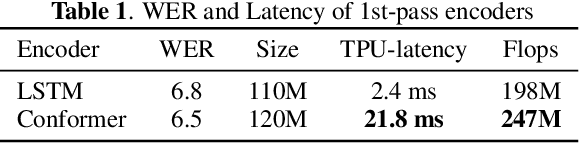

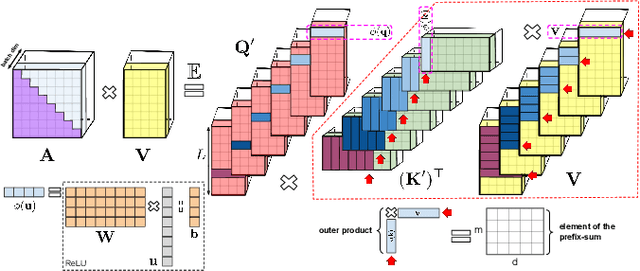
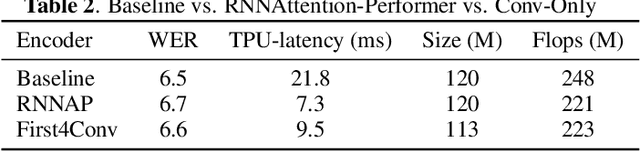
Conformer models maintain a large number of internal states, the vast majority of which are associated with self-attention layers. With limited memory bandwidth, reading these from memory at each inference step can slow down inference. In this paper, we design an optimized conformer that is small enough to meet on-device restrictions and has fast inference on TPUs. We explore various ideas to improve the execution speed, including replacing lower conformer blocks with convolution-only blocks, strategically downsizing the architecture, and utilizing an RNNAttention-Performer. Our optimized conformer can be readily incorporated into a cascaded-encoder setting, allowing a second-pass decoder to operate on its output and improve the accuracy whenever more resources are available. Altogether, we find that these optimizations can reduce latency by a factor of 6.8x, and come at a reasonable trade-off in quality. With the cascaded second-pass, we show that the recognition accuracy is completely recoverable. Thus, our proposed encoder can double as a strong standalone encoder in on device, and as the first part of a high-performance ASR pipeline.
SLAM: A Unified Encoder for Speech and Language Modeling via Speech-Text Joint Pre-Training
Oct 20, 2021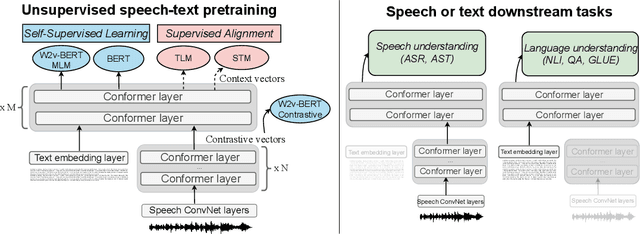
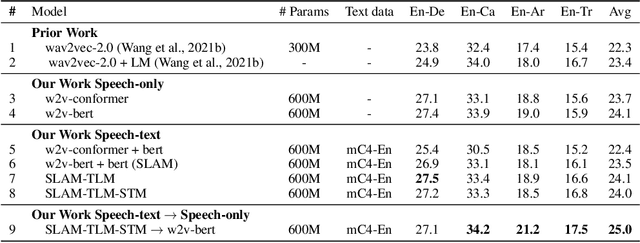
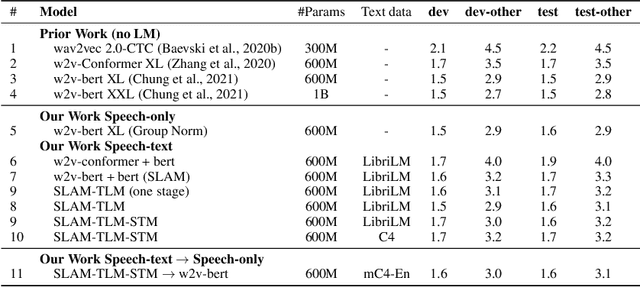
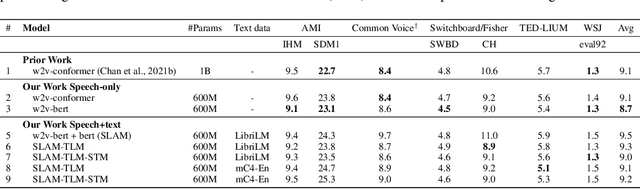
Unsupervised pre-training is now the predominant approach for both text and speech understanding. Self-attention models pre-trained on large amounts of unannotated data have been hugely successful when fine-tuned on downstream tasks from a variety of domains and languages. This paper takes the universality of unsupervised language pre-training one step further, by unifying speech and text pre-training within a single model. We build a single encoder with the BERT objective on unlabeled text together with the w2v-BERT objective on unlabeled speech. To further align our model representations across modalities, we leverage alignment losses, specifically Translation Language Modeling (TLM) and Speech Text Matching (STM) that make use of supervised speech-text recognition data. We demonstrate that incorporating both speech and text data during pre-training can significantly improve downstream quality on CoVoST~2 speech translation, by around 1 BLEU compared to single-modality pre-trained models, while retaining close to SotA performance on LibriSpeech and SpeechStew ASR tasks. On four GLUE tasks and text-normalization, we observe evidence of capacity limitations and interference between the two modalities, leading to degraded performance compared to an equivalent text-only model, while still being competitive with BERT. Through extensive empirical analysis we also demonstrate the importance of the choice of objective function for speech pre-training, and the beneficial effect of adding additional supervised signals on the quality of the learned representations.
BigSSL: Exploring the Frontier of Large-Scale Semi-Supervised Learning for Automatic Speech Recognition
Oct 01, 2021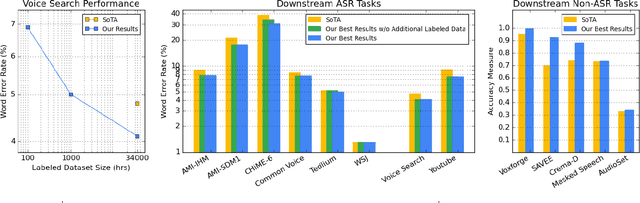
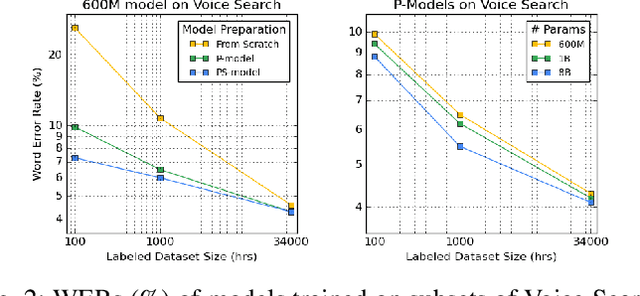
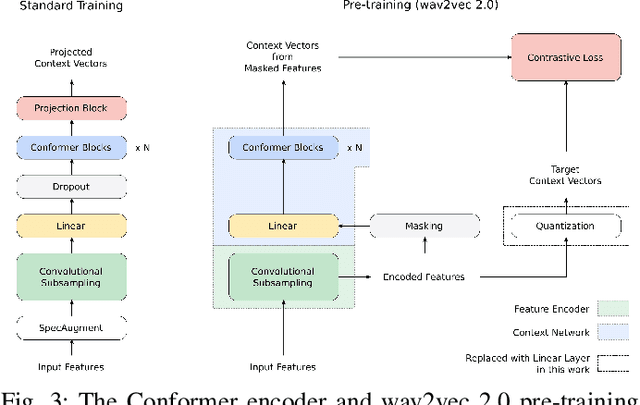
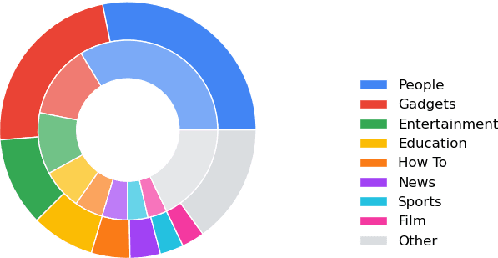
We summarize the results of a host of efforts using giant automatic speech recognition (ASR) models pre-trained using large, diverse unlabeled datasets containing approximately a million hours of audio. We find that the combination of pre-training, self-training and scaling up model size greatly increases data efficiency, even for extremely large tasks with tens of thousands of hours of labeled data. In particular, on an ASR task with 34k hours of labeled data, by fine-tuning an 8 billion parameter pre-trained Conformer model we can match state-of-the-art (SoTA) performance with only 3% of the training data and significantly improve SoTA with the full training set. We also report on the universal benefits gained from using big pre-trained and self-trained models for a large set of downstream tasks that cover a wide range of speech domains and span multiple orders of magnitudes of dataset sizes, including obtaining SoTA performance on many public benchmarks. In addition, we utilize the learned representation of pre-trained networks to achieve SoTA results on non-ASR tasks.
Scaling End-to-End Models for Large-Scale Multilingual ASR
Apr 30, 2021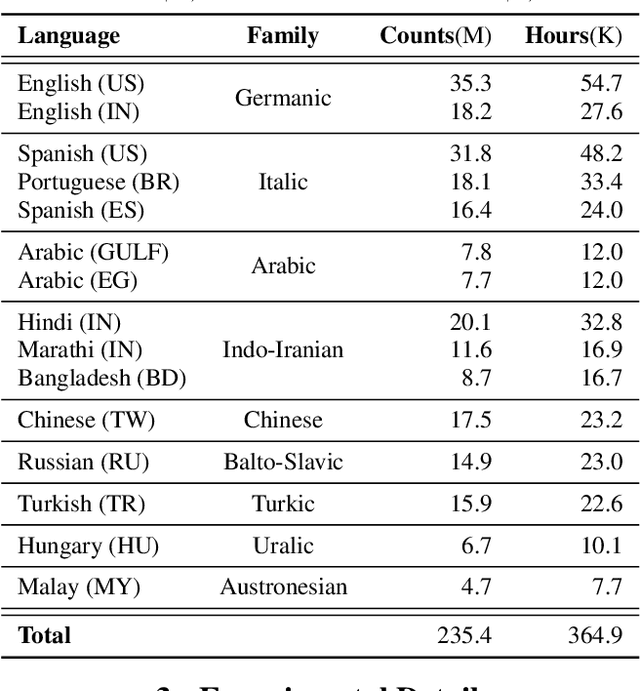
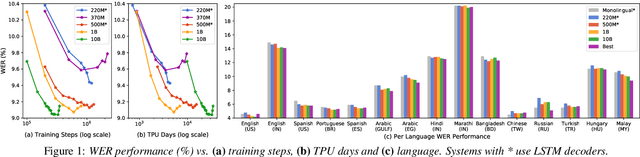
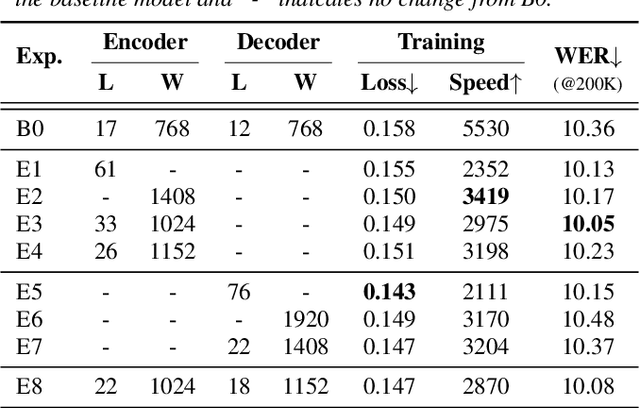
Building ASR models across many language families is a challenging multi-task learning problem due to large language variations and heavily unbalanced data. Existing work has shown positive transfer from high resource to low resource languages. However, degradations on high resource languages are commonly observed due to interference from the heterogeneous multilingual data and reduction in per-language capacity. We conduct a capacity study on a 15-language task, with the amount of data per language varying from 7.7K to 54.7K hours. We adopt GShard [1] to efficiently scale up to 10B parameters. Empirically, we find that (1) scaling the number of model parameters is an effective way to solve the capacity bottleneck - our 500M-param model is already better than monolingual baselines and scaling it to 1B and 10B brought further quality gains; (2) larger models are not only more data efficient, but also more efficient in terms of training cost as measured in TPU days - the 1B-param model reaches the same accuracy at 34% of training time as the 500M-param model; (3) given a fixed capacity budget, adding depth usually works better than width and large encoders tend to do better than large decoders.
FastEmit: Low-latency Streaming ASR with Sequence-level Emission Regularization
Oct 21, 2020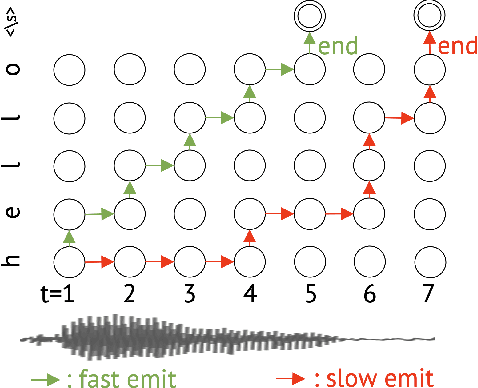
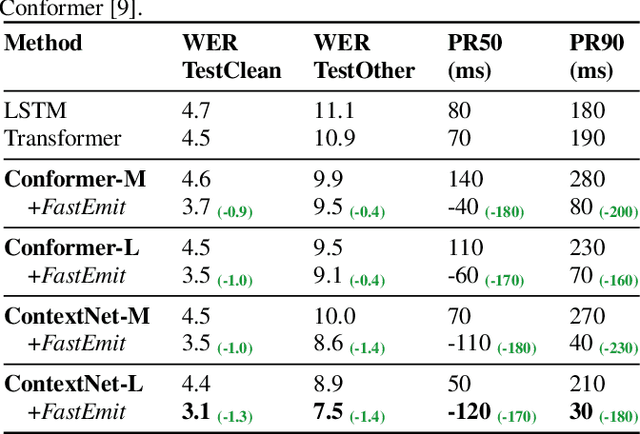

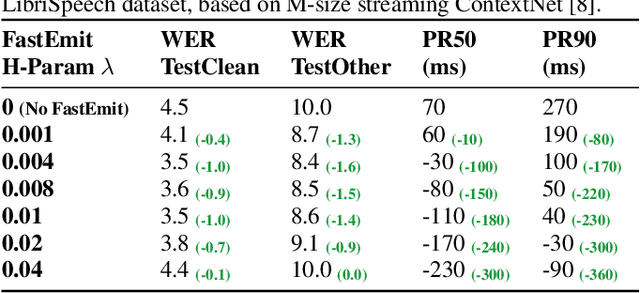
Streaming automatic speech recognition (ASR) aims to emit each hypothesized word as quickly and accurately as possible. However, emitting fast without degrading quality, as measured by word error rate (WER), is highly challenging. Existing approaches including Early and Late Penalties and Constrained Alignments penalize emission delay by manipulating per-token or per-frame probability prediction in sequence transducer models. While being successful in reducing delay, these approaches suffer from significant accuracy regression and also require additional word alignment information from an existing model. In this work, we propose a sequence-level emission regularization method, named FastEmit, that applies latency regularization directly on per-sequence probability in training transducer models, and does not require any alignment. We demonstrate that FastEmit is more suitable to the sequence-level optimization of transducer models for streaming ASR by applying it on various end-to-end streaming ASR networks including RNN-Transducer, Transformer-Transducer, ConvNet-Transducer and Conformer-Transducer. We achieve 150-300 ms latency reduction with significantly better accuracy over previous techniques on a Voice Search test set. FastEmit also improves streaming ASR accuracy from 4.4%/8.9% to 3.1%/7.5% WER, meanwhile reduces 90th percentile latency from 210 ms to only 30 ms on LibriSpeech.